Sound Design Evolution: From Mechanical Clicks to Digital Symphonies in Online Reel and Wheel Entertainment
Written by Clara Werner · Aug 14, 2026

Sound Design Evolution: From Mechanical Clicks to Digital Symphonies in Online Reel and Wheel Entertainment
Mechanical reel machines from the early twentieth century relied on physical components that generated their own audio signatures, and those sounds became central to how players experienced each spin. Metal reels meshed with gears while levers released springs, all of which created rhythmic clicks and clacks that operators could hear across casino floors. Observers note that these auditory cues served practical purposes because they confirmed reel stops and payouts without requiring visual confirmation every time.
Electromechanical Shifts in Mid-Century Designs
By the 1960s manufacturers introduced electric motors and solenoids that replaced many manual actions, yet the resulting chimes and buzzers retained a connection to the older mechanical era. Research from the University of Nevada's International Gaming Institute shows that these hybrid machines used amplified bells and buzzers to signal wins, and data collected from Nevada Gaming Control Board archives reveals steady increases in machine volume settings through the 1970s. Players quickly associated particular tone sequences with different payout tiers, which encouraged repeated play sessions on the same units.
Digital Audio Arrives in Land-Based Cabinets
The 1980s brought microprocessors into slot cabinets, allowing engineers to replace physical sound generators with stored samples that played through small speakers. Those early digital chips reproduced sampled bell rings and reel-stop effects, yet the audio remained monaural and looped in short patterns. Technicians adjusted sample rates and bit depths to fit limited memory, which produced the characteristic 8-bit quality still recognizable in vintage machines today. This period marked the first time sound designers could layer multiple effects without adding extra hardware components.
Online Platforms Expand the Sonic Palette
Internet-based reel and wheel games emerged in the mid-1990s, and developers gained access to larger storage and higher bandwidth that supported richer sound files. Game studios began recording custom orchestral hits and ambient textures that played in response to reel stops or wheel segments landing on specific outcomes. Adaptive mixing systems adjusted volume and panning based on player settings and session length, while background tracks shifted during bonus rounds to maintain engagement. In August 2026 several major platforms rolled out spatial audio updates that used device gyroscopes to alter sound directionality when users tilted their phones during live dealer roulette sessions.
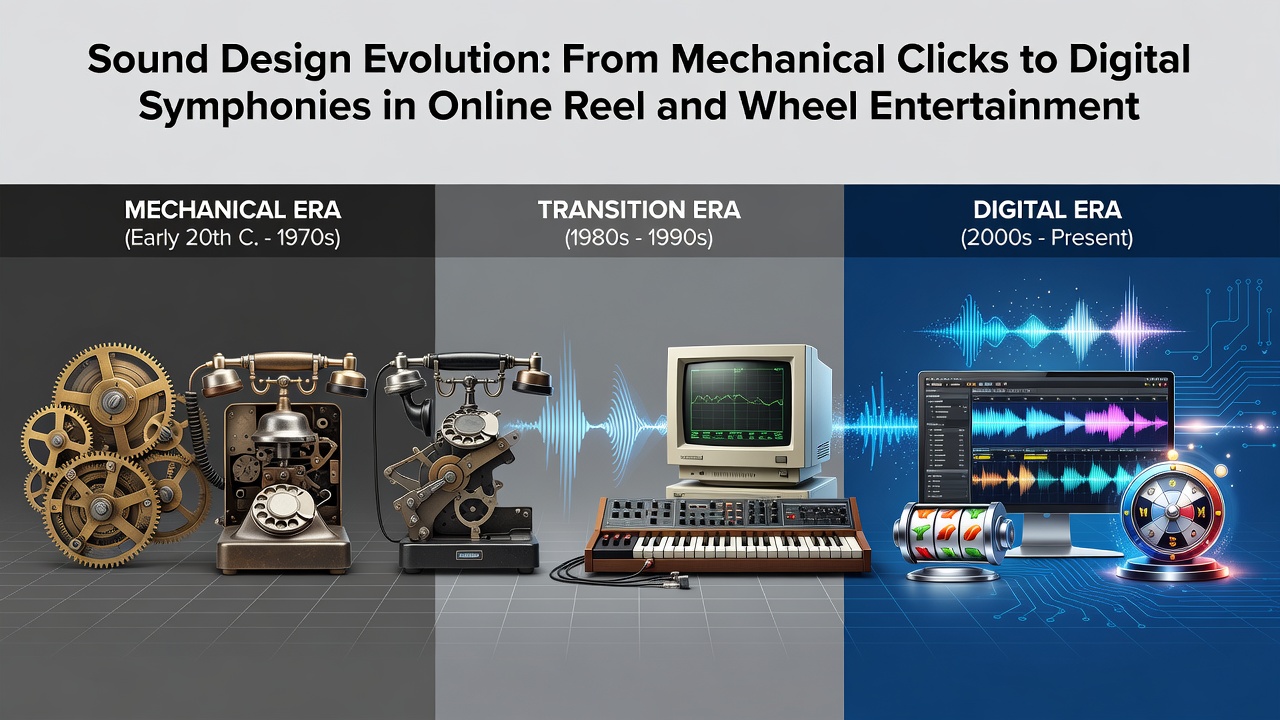
Wheel-based games adopted similar techniques, replacing the single clack of a physical ball with layered whooshes, friction sounds, and celebratory stingers that matched virtual ball trajectories. Audio middleware tools allowed real-time parameter changes so that a near-miss on a roulette number produced a distinct tonal shift compared with a clean miss. Engineers synchronized these cues with animation frames to preserve the illusion of physical causality even though outcomes derived from random number generators.
Current Standards and Regulatory Influences
Regulators in multiple jurisdictions now require clear audio feedback for win notifications and responsible gaming alerts, which has standardized certain sound design practices across markets. Figures from the Australian Communications and Media Authority indicate that licensed operators must maintain minimum volume thresholds for critical game events while permitting users to mute non-essential tracks. Developers therefore create modular audio banks that operators can configure without altering core game logic, and testing protocols verify that every payout combination triggers an appropriate sonic response within defined latency limits.
Case studies from European testing labs demonstrate that games using dynamic music layers retain player attention longer than titles with static loops, although the precise mechanisms remain under study. Sound designers collaborate with mathematicians to map audio intensity curves against volatility profiles, ensuring that high-variance reel sequences receive more dramatic musical builds while steadier wheel segments maintain calmer ambient beds. These pairings appear consistently across current mobile releases that support both portrait and landscape orientations.
Conclusion
The progression from mechanical clicks to layered digital compositions reflects broader advances in computing power, storage capacity, and network delivery. Each era preserved the core function of sound as an immediate feedback mechanism while expanding the range of emotional cues available to designers. As hardware continues to improve, reel and wheel titles incorporate higher-resolution samples and more sophisticated mixing engines that respond to individual device capabilities and player preferences.